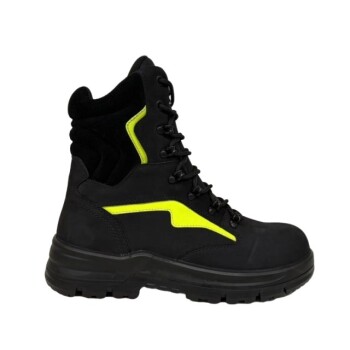
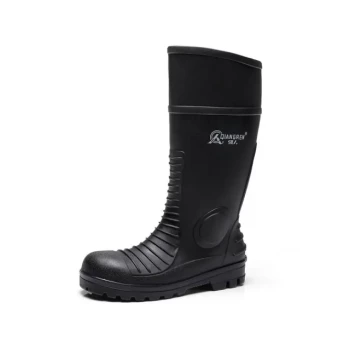
Professional protective footwear functions as a primary mechanical stabilizer for the lower body, serving as the first line of defense against joint degradation. Its fundamental role is to influence gait patterns by stabilizing the foot and ankle, which ensures a balanced weight distribution across the lower extremities. By providing mechanical support and cushioning, these specialized shoes minimize the transmission of harmful physical forces that would otherwise cause excessive wear on knee joint cartilage.
By stabilizing the foot and ankle, professional footwear alters how physical forces travel up the leg, effectively reducing the impact load on the knee. This mechanical intervention is critical for preserving joint cartilage during repetitive high-impact activities.
The Mechanics of Joint Protection
To understand how footwear protects the knee, one must look at how it alters the kinetic chain—the connected movement of foot, ankle, and knee.
Stabilizing the Foundation
The primary mechanism of protection is foot and ankle stabilization.
By securing the lower foundation of the body, protective footwear prevents erratic or compensatory movements.
This stability reduces the need for the knee to make micro-adjustments, allowing for a more predictable and safe gait pattern.
Distributing Weight Evenly
Unbalanced weight distribution creates "hot spots" of pressure within the knee joint.
Professional footwear is engineered to enforce a balanced distribution of body weight across the foot.
This ensures that no single part of the knee joint bears a disproportionate amount of load, thereby reducing the risk of localized cartilage damage.
Cushioning and Force Reduction
The materials used in professional footwear act as a shock absorber.
This cushioning dampens the energy generated when the foot strikes the ground.
By absorbing this energy at the source, the footwear minimizes the physical forces transmitted upward into the knee joint.
The Critical Role of Surface Interaction
While the internal structure of the shoe provides support, the interaction between the sole and the floor is equally vital for knee safety.
The Impact of Friction Coefficients
The friction coefficient between the shoe and the floor directly dictates biomechanical stress.
This interaction determines how much force is generated and subsequently transferred to the skeletal structure.
Managing Instantaneous Loads
During rapid movements or wide-stepping actions, the foot exerts significant force against the ground.
If the friction is high, these forces are converted into instantaneous loads on the knee.
Managing this friction is essential to prevent sudden spikes in joint pressure that can lead to acute injury.
Understanding the Trade-offs: Grip vs. Load
While stability is the goal, there is a complex relationship between traction and joint stress that must be carefully managed.
The Risk of Excessive Traction
It is a common misconception that maximum grip is always safer.
High friction levels, often found in new shoe soles, can actually increase the instantaneous load on the knee.
If the foot is anchored too aggressively by the floor, the rotational and shear forces are absorbed by the knee joint rather than dissipated by the shoe.
Balancing Performance and Protection
Professional training shoes must incorporate scientifically designed grip patterns.
These patterns aim to strike a precise balance: enough grip to support athletic performance, but enough give to protect the knee.
Ignoring this balance can lead to increased biomechanical strain, negating the benefits of cushioning and support.
Making the Right Choice for Your Goal
Selecting the correct footwear requires analyzing the specific demands of your activity and the surface you are working on.
- If your primary focus is reducing long-term joint wear: Prioritize footwear with maximum ankle stabilization and cushioning to minimize impact transmission to the cartilage.
- If your primary focus is safety during rapid, lateral movements: Select footwear with scientifically balanced grip patterns to prevent excessive instantaneous loads caused by high friction.
The right footwear is not merely an accessory; it is a calibrated mechanical tool essential for maintaining long-term knee health.
Summary Table:
| Mechanism | Primary Function | Impact on Knee Health |
|---|---|---|
| Ankle Stabilization | Prevents compensatory micro-adjustments | Reduces erratic joint strain and wear |
| Weight Distribution | Enforces balanced pressure across the foot | Eliminates localized pressure "hot spots" |
| Shock Absorption | Dampens energy during ground strike | Minimizes force transmission to cartilage |
| Friction Control | Balances grip vs. surface give | Prevents high-impact instantaneous loads |
Protect Your Team’s Long-Term Mobility with 3515
As a large-scale manufacturer serving distributors and brand owners, 3515 offers comprehensive production capabilities for all footwear types, anchored by our flagship Safety Shoes series. Our expert engineering ensures that every pair—from work and tactical boots to training shoes and sneakers—provides the precise mechanical stabilization needed to reduce knee joint load and enhance gait safety.
Whether you need robust industrial protection or high-performance athletic footwear, we deliver bulk solutions tailored to your technical requirements. Contact us today to discuss how our manufacturing expertise can add value to your brand and protect your end-users.
相关产品
大家还在问
- Why does the material performance of professional slip-resistant shoes offer superior safety? Hardware vs. Behavior
- Why is it mandatory to wear safety shoes with steel toe protection during metal loading? Prevent Crushing Injuries
- 为什么建议在选择安全鞋时寻求专家帮助?确保完美贴合与危害防护
- What is the purpose of requiring subjects to wear anti-slip socks and tight-fitting sportswear? Optimize Sensor Data
- 仓库工作鞋应包含哪些安全要素?全天候防护的关键特性