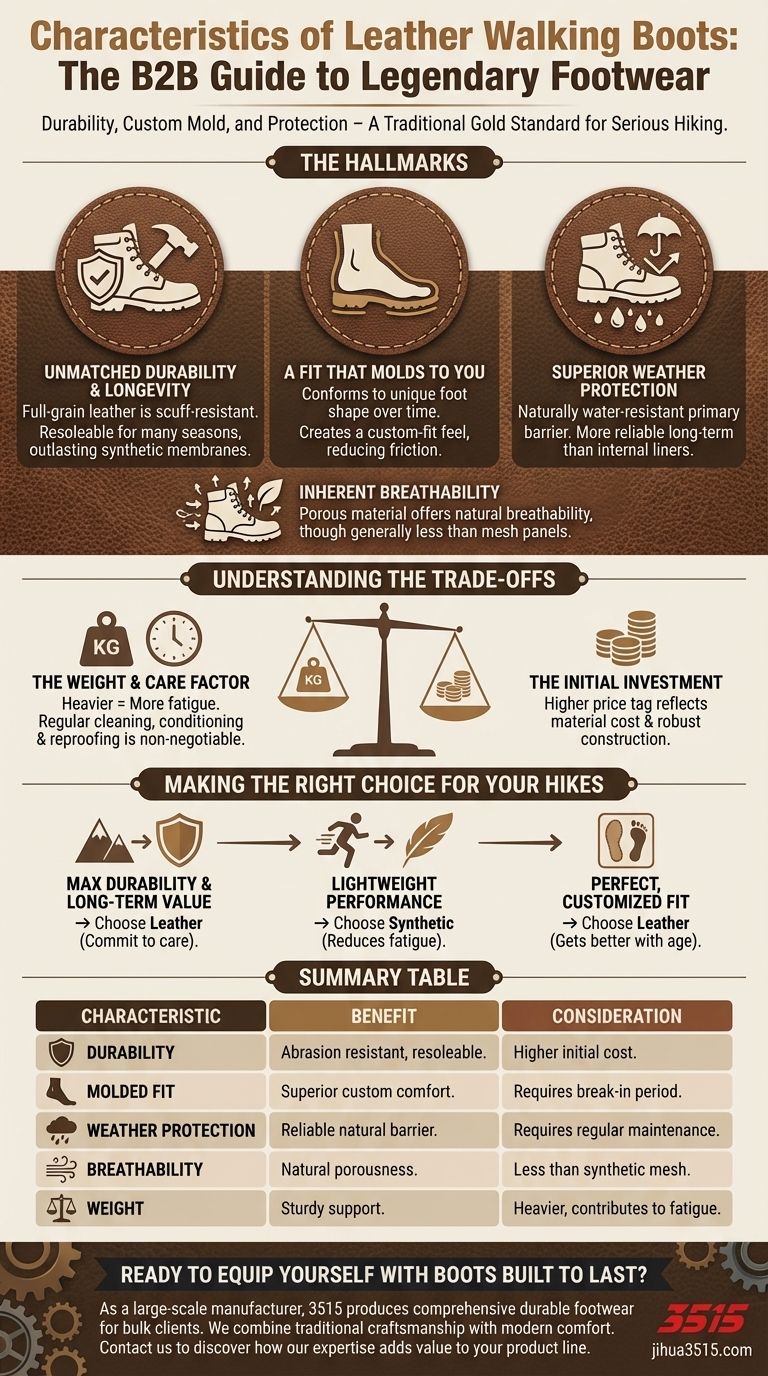
At their core, leather walking boots are defined by their exceptional durability, their unique ability to mold to your foot over time, and their robust protection from the elements. These characteristics make them a traditional gold standard for serious hiking, but they come with specific trade-offs in weight and maintenance that modern synthetic boots do not have.
Choosing leather is a long-term investment. You are trading the immediate, lightweight convenience of synthetic materials for unparalleled longevity and a truly customized fit, but only if you are willing to provide consistent care.
The Hallmarks of a Leather Walking Boot
Leather has been the material of choice for footwear for thousands of years for good reason. Its natural properties offer a unique combination of strength, comfort, and reliability that is difficult to engineer.
Unmatched Durability and Longevity
Full-grain leather is an exceptionally tough material, highly resistant to the scuffs and scrapes common on abrasive, rocky trails.
Unlike many synthetic boots that are retired once a waterproof membrane fails, a well-maintained leather boot can provide many seasons of use.
Furthermore, their sturdy construction often allows for resoling, extending their usable life far beyond that of a typical fabric boot.
A Fit That Molds to You
The most prized characteristic of leather is its ability to conform to the unique shape of your foot over time.
While older designs required a significant, often uncomfortable "break-in" period, modern leather boots are much more comfortable out of the box.
Even so, they still undergo a molding process, creating a custom-fit feel that reduces friction and improves comfort on long treks.
Superior Weather Protection
Leather is naturally water-resistant and provides excellent protection against the elements.
Properly cared for, the material itself acts as the primary barrier against moisture. This can be more reliable long-term than synthetic boots that depend solely on an internal waterproof liner, which can wear out or be punctured over time.
Inherent Breathability
As a natural material, leather is porous and possesses a degree of natural breathability.
However, it is crucial to note that it is generally less breathable than the mesh panels found on many modern synthetic and fabric boots.
Understanding the Trade-offs
The benefits of leather do not come without compromises. Understanding these trade-offs is essential to determining if leather boots are the right choice for your specific needs.
The Weight Factor
There is no getting around it: leather boots are heavier than their synthetic counterparts. This added weight can contribute to fatigue, particularly on high-mileage days.
The Commitment to Care
To achieve their legendary longevity, leather boots require regular maintenance.
This involves cleaning after use, occasional conditioning to keep the leather from drying out and cracking, and reproofing to maintain water resistance. This care is non-negotiable.
The Initial Investment
Leather boots often come with a higher price tag than many fabric options. This reflects the cost of the material and the robust construction required to work with it.
Making the Right Choice for Your Hikes
Deciding between leather and other materials depends entirely on your priorities and the type of hiking you do.
- If your primary focus is maximum durability and long-term value: A leather boot is the superior choice, provided you commit to its care.
- If your primary focus is lightweight performance for fast-paced treks: A modern synthetic boot will likely serve you better by reducing fatigue.
- If your primary focus is a perfect, customized fit for challenging terrain: The way a quality leather boot molds to your foot is an advantage that's hard to replicate.
Ultimately, choosing leather is choosing a reliable partner for the trail that gets better with age.
Summary Table:
| Characteristic | Benefit | Consideration |
|---|---|---|
| Durability & Longevity | Highly resistant to abrasion; often resoleable for extended life. | Higher initial investment compared to synthetic boots. |
| Molded Fit | Conforms to the unique shape of your foot for superior comfort. | Requires a break-in period to achieve the custom fit. |
| Weather Protection | Naturally water-resistant; provides a reliable barrier against elements. | Requires regular maintenance (cleaning, conditioning) to maintain performance. |
| Breathability | Offers natural breathability as a porous material. | Generally less breathable than modern mesh-panel synthetic boots. |
| Weight | Provides sturdy ankle support and stability on rough terrain. | Heavier than most synthetic alternatives, which can contribute to fatigue. |
Ready to equip yourself with boots built to last?
As a large-scale manufacturer, 3515 produces a comprehensive range of durable footwear for distributors, brand owners, and bulk clients. Our production capabilities encompass all types of leather walking boots, combining traditional craftsmanship with modern comfort.
We help our partners offer their customers the legendary durability, custom fit, and superior protection that only quality leather boots can provide.
Contact 3515 today to discuss your leather walking boot needs and discover how our manufacturing expertise can add value to your product line.
图解指南